VJ Day 80
VJ Day marks the anniversary of 15 August 1945 when Japan announced its surrender to the Allied forces. To mark this occasion Kenilworth Town Council are holding a short commemorative service at the War Memorial at Abbey End (top of Abbey Fields) on Friday 15 August 2025 at 11am. All are welcome to join us.
Kenilworth Town Council also wish to collate and publish local memories and connections of Kenilworth residents to Victory in Japan and the conflict in the Far East. If a Kenilworth resident has a relative who was a Prisoner of War, linked to the Burma Campaign or involved in the Pacific Theatre, and are happy to share your memories with the Town Council and for these to be displayed on our website, please send these by email at kentc@kenilworth-tc.gov.uk
Kenilworth Memories
Walter Lewis Galley
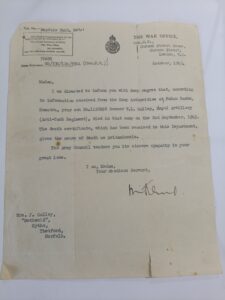
I thought you might like to know about my Unlcle Lewis (Walter Lewis Galley). I never had the chance to meet my Uncle (my mum’s brother), but I feel through conversations with my mum over the years until she passed away 5 years ago that I did know him. My mum was so proud of the brother that she lost, cause of death registerd as ‘Avitaminosis’. Through brutal slavery, starvation and poor diet, he died at Pakan Baroe camp on 2nd September 1945, the very day that Japan finally surrendered. He served as a Gunner in the Royal Artillery and was moved with his comrades from camp to camp in terrain so unfamiliar to home, to build the notorious Burma Railway. I am the family custodian of Uncle Lewis’s telegram sent home to my Grandmother and the letter from the War Office confirming that he wasn’t coming home to his mother and five siblings Following his father’s untimely death, having been tragically killed some 5 years previously, the family home consisted of two railway carriages in the middle of the Norfolk fens. Before he went off to fight for his country Uncle Lewis used to tend the crops on their smallholding, taking their two shire horses out to plough the fileds every day to provide food for the family. he was sorely missed. I understand from my family that he was a very talented artist and I often wonder if he was able to make any sketches of his life in the camps. My Grandmother never ever recovered from the tragic news of his death and suffering ill health for the rest of her life, she passed away within a few years of his death. I have recently made an application for my Uncle’s medals and made a promise to my mum that I would never let Uncle Lewis’s name be forgotten. – Diane Shores

George Roberts Dakin
Army No. 1154272 Born 27th August 1916 – 53 Albion Street, Kenilworth.
Declared for active service on 3rd September 1939 – living at 53 Albion Street, Kenilworth
Like most men who served in Burma and the Far East, our dad did not like to talk about his experiences in the war. We witnessed his emotions on certain occasions either when something was triggered by stories in the media (the death of Lord Mountbatten being one), whenever Vera Lynn was singing or if the Gurkhas were mentioned. We know he held “Johnny Gurkha” in high esteem and spoke fondly of them. Our mum told us he suffered nightmares most likely due to deep rooted emotions and memories. Just before he died he did talk in his sleep about being buried alive. It was clear from his words that this had been a harrowing experience. Even our mum was not aware of this so he had obviously buried it deep in his sub conscious.
Although declared on active service on 3rd September 1939, Dad was not posted until 4th June 1942 continuing his work as a bricklayer until then. He was posted as a Gunner to the 50th Anti-Tank Training Regiment B Battery of the Royal Artillery based at Church Stretton. One of the few things he did mention in passing was the training exercises on the Long Mynd but he didn’t elaborate on details.
Just over a month later he was posted to the Royal Artillery 176th Field Regiment Q Battery and then moved with them to Launceston, Cornwall on 24th September 1942. From our own research this appears to have been further training and defence of the British coastline. Dad’s training appears to have ended on 22nd December 1942 and he embarked for Bombay on 16th January 1943. The journey there was a long one lasting almost three months with disembarkation on 8th April 1943. He appears to have then been taken to a camp at Deolali arriving on 14th April 1943. We suspect this would have involved a march there as we don’t imagine transfer taxis were waiting! Deolali was not a permanent garrison, merely a transit point for soldiers and “Dolally” became a slang term for “mad” or “eccentric” due to the poor conditions and the waiting around some soldiers had to endure in these conditions.
However, Dad wasn’t there for too long as his records show a transfer to the 240th Field Regiment in Ceylon on 18th June 1943 where he remained for just over five months. He transferred back to India on 27th November 1943 where, he was shown as attending two Signallers Courses in June and November 1944.
In April 1945, Dad was classified as sick and our memories recall him talking about having Malaria so we suspect that was at this point. It’s not clear how long he was considered “sick” but in September 1945 he was posted to 28th Field Regiment and then almost straight on to 115th Field Regiment.
On 2nd April 1946 he was moved to a transit camp ready for repatriation, embarking from Rangoon on the 6th of that month.
He then spent six months at Woolwich Barracks until his return home on 24th December 1946. During his time there he was employed as a gunner and a member of the regimental police, none of which we were aware of until receipt of his army records after he passed away. His military conduct was declared as exemplary and he was described as an honest, trustworthy and reliable man with a good sense of responsibility and able to carry out tasks without supervision. We feel he displayed these qualities throughout his life and instilled those same qualities into us in a quiet and unassuming manner. He had a real sense of justice and fairness to his fellow man and again displayed those always, again instilling those into our lives.
Surprisingly he was still considered as part of “Reserve Liability” until the end of June 1959, just before his youngest child was born- so in the time that he had left Woolwich, married and had children he could still have been recalled to duty. It must have been a relief to him after his experiences to know he would not be called upon again in that capacity. In fact, Dad’s reluctance to talk or think about his experiences meant he only claimed his war medals in November 1966 and after much persuasion from his family. He did join the local Burma Star Association later and was proud to be involved with their parades/events etc. – perhaps this afforded him the opportunity to be with people who understood the difficulties they had all faced – Richard Dakin, Anne Holmes and Sandra Driver
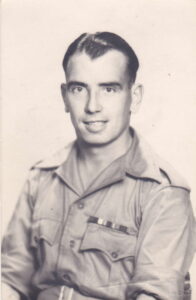
Anthony Edward Gordon
Anthony Edward Gordon was born on the 24th July 1922. Both sides of his family were military.
When WW2 began, he was 17 and joined REME (Royal Electrical and Mechanical Engineers).
He never saw service in Europe but was in North Africa and when VE day came he was in Burma with 3 more months of fighting ahead of him. By then he was a Chindit. Created by Major Wingate, the Chindits were a special operations unit for long range penetration and operated behind the Japanese Lines. The Chindits badge was based on the fabulous lions which guard the entrances to Burmese pagodas. There were involved in two main campaigns in Burma.
Tony never talked about the horrors of the war. He was a Roman Catholic when he joined the army, taking a small bible and rosary beads with him, but lost his faith in the horror of the war.
Tony did enjoy mentioning some of the light hearted events:
He was in Tobruk during an air raid. Stukas were dive bombing, so he dived under a tank for cover. When the air raid had finished, he got up and hit his head on the tank, which to his surprise moved upwards as he hit it. He discovered that he only went and took cover under a dummy rubber tank.
Tony’s Uncle Simon Austin was in the Black Watch troop and when they started to push Rommel back, the Black Watch was at the front. The were known for leaving the “water holes” quite dry when they moved on. So, Simon would buy a pint for Tony at every water hole as he knew his nephew was in the following group.
During the Chindits second campaign they used gliders to transport the troops and equipment to their starting points. The Chindits used Mules to carry equipment, but in Tony’s glider one mule became agitated and started kicking holes in the glider, but there was nothing they could do. The gliders were made out of wood so they just had to fly with a massive hole in the side. After that, Tony never had a good thing to say about Mules.
When the war in the Far East ended, his service wasn’t over. He was part of the early British atomic bomb tests where the only protection he had was the advice to turn his back to the explosion.
Tony was awarded an OBE for his military service, but he turned it down saying he did what he did was for King and Country, not for his own benefit – Simon Gordon
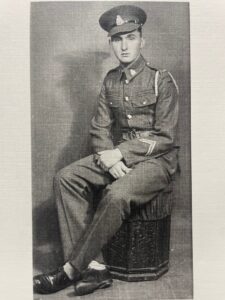
Gordon Leonard Truman
My father Gordon Leonard Truman was a Corporal in the Royal Army Medical Corps. He served with the 82nd West African Division, 3rd Gold Coast Regiment, fighting in Western Burma. He was in charge of Commonwealth soldiers, recruited from Nigeria, and Indians recruited en route to Burma. It was thought that West Africans could tolerate the Burmese tropical rainforest conditions better – including Bilharzia and Malaria – although my father said that all the recruits lived in the city of Lagos and had never seen a jungle.
In the jungle at the Pegu Yomas river we dug our slit trenches side by side on the bank with Machetes which broke the soil and a mess tin scooped it out, so in the course of our stayof two weeks it became five feet long and three feet deep. A general arrangement developed: we moved by day, the Japanese by night.
Fresh water was essential in that heat. My father was tasked to look for fresh water at night – a very dangerous undertaking indeed – Alix Dearing.
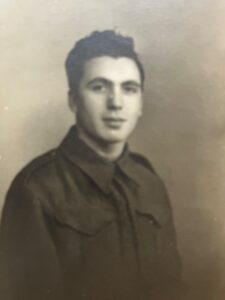
George Leonard Hopkins & Walter Arthur Johnston
From Australia to England – A Personal VJ Day Tribute
This VJ Day, Donna Curtis will lay a wreath at her local cenotaph in England. It’s an honour for any Australian living abroad, but for Donna, it carries personal significance.
Both her grandfathers served in the Second World War. Both made it home. And both carried the weight of those years in their own way.
Her maternal grandfather, George Leonard Hopkins – known in the family as “Pop” – was stationed in Darwin during the Japanese bombing raids of 1942 and 1943. He worked in supply and logistics, keeping a vital outpost running under pressure. He returned home after sustaining injuries but died young, at just 42, leaving behind a wife and eight children. Donna’s mother was only 13 at the time.
“Like so many of his generation, he didn’t talk about the war,” Donna said. “We don’t have much – just a few stories and the knowledge that he served.”
Her paternal grandfather, Walter Arthur Johnston – “Pa” – left a deeper imprint. He lived on the farm next door when Donna was growing up on the outskirts of Sydney and his character loomed large in her childhood.
He enlisted in 1940, lying about his age to qualify, and left behind his young wife, Jean, who was pregnant with their first child in 1941. He was posted to Singapore – and taken prisoner when it fell in 1942. From there, he was sent to Changi and later forced to work on the notorious Burma–Thailand Railway.
Conditions were brutal. More than 7,000 Australian POWs died from disease, starvation and violence. Walter, a bush kid and one of 13 children, relied on skills learned during the Depression – how to forage, how to survive, how to help others.
One story passed down in the family has become legend. One Christmas, he managed to save scraps of rice, a little fruit and one precious egg. With it, he made a Christmas pudding, cooked in his POW lap-lap. “He said it wasn’t Christmas without one,” Donna smiled. “It became one of those cheeky family stories – light-hearted, but when you think about it, deeply courageous.”
Another story left a lasting impression. While at Changi, he was called to a Japanese officer’s quarters. On the desk, he spotted a partially visible photograph. It was Jean – and beside her, a baby girl. It was the first time he realised he was a father. His daughter Kitty had been born on Christmas Day 1941.
Meanwhile, Jean was raising Kitty alone, working on the farm and delivering milk. In April 1942, she was told her husband was missing. For more than three years, she had no idea if he was alive.
When the war ended, Walter – like many emaciated POWs – was first sent to Japan to recover, then to Manila. He returned to Australia in October 1945 and was discharged that December.
He and Jean had two more children, including Donna’s father, Bob – named after a fellow POW from Melbourne whom Walter had helped survive. “Uncle Bob”, as Donna knew him, remained close with the family for life. The two families often travelled to visit each other in later years.
Walter never spoke much about those years. Like many veterans, he carried a heavy load. He drank heavily for a long time – but gave it up in the 1970s. Despite the trauma, he built a good life, ran a successful orchard and nursery with his son, and was known for his mischief, strength and dry humour.
“He was a real character – full of Aussie grit and cheek,” Donna said. “He could be tough, but he had a big heart under it all. He really was remarkable”
Walter passed away in 1997, aged 77. Jean lived to nearly 100.
Now living in England, Donna says her wreath honours more than just her family. “It’s not just about those who fought – it’s also about the women who waited and the children who hoped,” she said. “I feel proud to share their story.”
Lest we forget.
Thomas Marsh
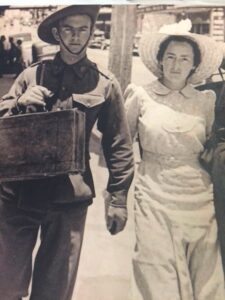
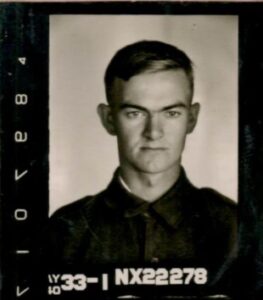
Today, I’d like to pay tribute to two members of my family who served in Southeast Asia during the Second World War.
My father, Thomas F.A. Marsh, joined the British Army before the war began in 1939. Serving with the Royal Artillery, he saw action in Egypt and India, later in the dense jungles of Burma. Commissioned in the field, he rose to the rank of Acting Major. He rarely spoke of the hardships of jungle warfare, once coming face to face with a King Cobra, and another time engaging a Japanese soldier in close quarters, unsure afterwards who had screamed the loudest. He left the army in 1947 with the honorary rank of Captain, carrying with him not only a deep sense of duty, but a lifelong wariness of snakes.
My great-uncle, Richard Milne, was captured by the Japanese in 1942 and endured the horrors of the Burma Railway as a prisoner of war. After years of silence and uncertainty, the family finally received word in October 1945 that he had survived and was in Melbourne, waiting for a ship to bring him home.
Their stories are a poignant reminder of the sacrifice, resilience and humanity shown by so many in that brutal theatre of war – Adrian Marsh
Rupert Wyatt-Smith
Story of Survival in Changi Prison
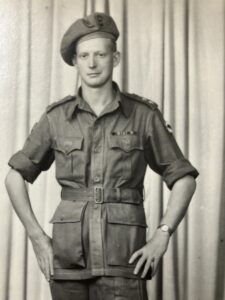
As the world commemorates the 80th anniversary of the end of World War II in the Pacific this week, the story of Rupert Wyatt-Smith — a former rubber plantation manager in Malaya — offers a sobering insight into the suffering endured by thousands of civilians and soldiers during the Japanese occupation of Southeast Asia.
In December 1941, as Japanese forces swept into northern Malaya, Rupert Wyatt-Smith made the decision to part from his family for their safety. He took his wife and two young children to Singapore, where they managed to board a boat bound for Australia. They would spend the remainder of the war there. Rupert, however, chose to stay behind, joining the Civil Defence Force to assist in resisting the Japanese advance.
When Singapore fell in February 1942 and Governor Sir Shenton Thomas formally surrendered to the Japanese, Rupert was among the thousands of civilians and military personnel taken as prisoners. Like many, he was marched to the now-infamous Changi Prison carrying what little he could.
“Little did I know when I walked to Changi that I would spend the next three years of my life there,” Rupert later wrote in memoirs he kept. “It had been built and used as a prison before the war, and when I was there, it must have held about two thousand men.”
Rupert was placed in a section that had once been a workshop. Over a hundred men lived and slept there, shoulder to shoulder, with little privacy or comfort. They wore nothing but loincloths, as clothing quickly wore away and supplies were nonexistent.
Early on, the Japanese forces sorted prisoners by age. “When they read my passport, they said, ‘No, too old’ and shook their heads,” he recalled. “They took everyone under forty and sent them to Burma to work on the railway. Very few of these came back.”
Survival in Changi was brutal. Meals consisted of little more than watery rice husk porridge in the morning and a mug of rice with green leaves in the afternoon. “Our weight loss was gradual, and we were not aware of how emaciated we were becoming,” Rupert wrote. At one point, he noticed a man entering the shower block who looked like a “walking skeleton.” A fellow prisoner told him: “Have you looked at yourself in the mirror lately? You look a lot worse.”
From his original weight of 12 stone (76kg), Rupert had withered to just 7 stone (44kg) by the time of his release.
His time in captivity was marked by brutality and fear. He described witnessing a fellow prisoner being kicked to death by Japanese soldiers for reasons unknown. “I kept out of the way of Japanese officers as much as possible,” he said. “There was no point asking for trouble.”
The Japanese guards often patrolled with drawn swords. Every time one entered a room, prisoners were required to stand to attention and bow.
After two years in Changi, Rupert was transferred to Sime Road Camp with the survivors of the Burma Railway. Though not a formal prison, Sime Road offered slight improvements. Prisoners were able to grow vegetables, easing the constant hunger. But for Rupert, the damage was already done.
He was suffering from beriberi, a disease caused by vitamin B1 deficiency, which left his feet grossly swollen and in constant pain. He also battled scabies and extreme fatigue. “When the end actually came, I was in no state to enjoy it,” he admitted.
The war ended in August 1945. Rupert recalled the moment freedom arrived: “We saw parachutes dropping around us, and the Japanese ran off as soon as they saw them. They were Gurkhas. Lots of people ran outside to meet them, but my feet were too bad for me to walk that far.”
After a six-week voyage home via Ceylon (now Sri Lanka) and Suez, Rupert finally returned to Liverpool
Rupert Wyatt-Smith’s story is a reminder of the courage and endurance of those who suffered behind barbed wire and prison walls – Miles Wyatt-Smith
Jack Rhodes
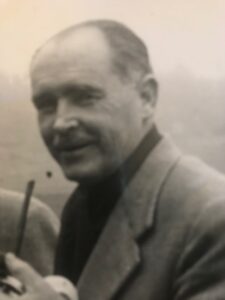
My father Jack Crawford Rhodes volunteered for the army and was in the Royal Artillery. His regiment sailed for Singapore in January 1942. However because of Singapore’s surrender to the Japanese the ship’s orders changed and they went to India.
Jack took part in the first Chindit Expedition under the leadership of Orde Wingate who my father admired. This was a daring raid behind Japanese front lines in Burma. The casualties were huge and the wounded had to be left behind but after walking and fighting for hundreds of miles the men who arrived back in India found they were now regarded as heroes.
My father was in the 33rd Indian Corps which was part of the 14th Army and was at the Battles of Imphal and Kohima. He once had the distinction of being the only person to have fallen asleep by the side of a large Medium Battery Gun while it was still in action after he and his comrades had been awake and fighting for many hours!
During his years in India and Burma he travelled many miles and had long journeys very often never knowing exactly where he was!
He had great respect for Bill Slim the General of the 14th Army and also Lord Mountbatten the Commander of the South East Asia Command. He told me that Mountbatten said to them that they were, “ not the Forgotten Army, they were not forgotten. Nobody knew they were there!”
He returned to this country at the end of 1945 and went back to his job in a leather factory. Not surprisingly he found it difficult to settle after being away for so long in such a distant country.
The men who took part in the Burma Campaign are all heroes and we are very proud of them. They are not forgotten now – Jackie Prestwich
VJ Day Links